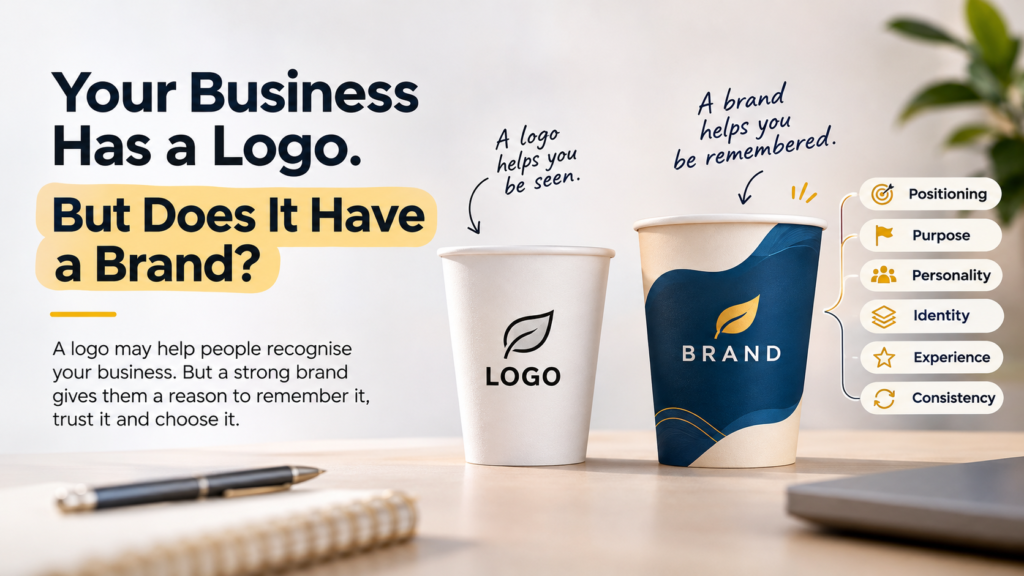
A logo may help people recognise your business. But a strong brand gives them a reason to remember it, trust it and choose it.
When someone starts a business, one of the first things they usually think about is the logo.
They choose colours, explore fonts, discuss design references and eventually arrive at something that looks good. The website follows. Social media pages are created. Marketing begins.
Everything seems to be in place.
But a few months later, an interesting problem often appears. People are seeing the business, but they are not necessarily remembering it. The company is posting regularly, but its communication feels inconsistent. Potential customers visit the website but struggle to understand what makes the business different.
This is where the difference between having a logo and building a brand becomes important.
A Brand Is Much More Than Its Visual Identity
Think about the businesses you remember and trust.
You probably don’t remember them only because of their logo. You remember how they communicate, what they stand for, the experience they provide and how consistently they deliver on their promises.
That is what a brand is built on.
A brand brings together several important elements:
- Positioning: What do you want your business to be known for?
- Purpose: Why does your business exist beyond selling a product or service?
- Personality: If your brand were a person, how would it speak and behave?
- Identity: What visual language represents your business?
- Experience: What do customers feel when they interact with you?
- Consistency: Does your brand communicate the same promise across every touchpoint?
A logo is one part of this larger picture.
Why Do Businesses Struggle With Brand Identity?
One common reason is that businesses start designing before defining what they want to communicate.
The logo is developed first. Then the website is designed. Social media creatives are created separately. Sales presentations follow another visual direction.
Over time, the brand begins to look and sound different across platforms.
The problem isn’t necessarily the quality of the designs. The problem is the absence of a clear brand foundation.
Without a defined strategy, every new communication becomes another isolated creative exercise.
Start With Positioning, Not Colours
Before deciding how a brand should look, it is worth answering a few basic questions:
- Who exactly are you trying to reach?
- What problem are you solving for them?
- Why should they choose you over another business?
- What should people remember about your company?
- What kind of experience do you want customers to associate with your brand?
These questions help establish the direction for your identity, messaging, website and marketing.
For example, two businesses may offer similar services but want to be perceived very differently. One may want to be known for affordability and accessibility, while the other may want to communicate expertise, personal attention and premium quality.
Their brand strategies, messaging and visual identities should reflect those differences.
A Strong Brand Creates Consistency
A customer might discover your business through Google, visit your website, see an Instagram post, read a LinkedIn update and eventually speak to your sales team.
Each interaction contributes to their perception of your business.
If your message changes at every touchpoint, trust becomes harder to establish.
A well-defined brand gives your team a common direction. It helps designers, marketers, salespeople and leadership communicate with greater clarity.
More importantly, it helps customers understand what they can expect from you.
When Should You Invest in Brand Strategy?
You don’t have to be a large company to think strategically about branding.
Brand strategy becomes especially important when:
- You are launching a new business or product.
- Your business is entering a new market.
- You are attracting a different customer segment.
- Your existing identity no longer reflects your business.
- Your marketing looks inconsistent across platforms.
- You are struggling to explain what makes your business different.
Sometimes the answer isn’t another advertising campaign or a new logo. It is taking a step back and understanding what your brand should stand for.
Our Perspective at Brand Synthesis Global
At Brand Synthesis Global, we believe branding should begin with understanding the business.
We look at the business, its audience, its market and its ambitions before moving towards positioning, identity and communication.
Our approach brings strategy, design and digital execution together so that the brand doesn’t just look consistent; it communicates with purpose.
Because a good logo can make someone notice your business.
A strong brand gives them a reason to remember it.
Building Brands for What’s Next.
If you are building a new business or thinking about repositioning an existing one, let’s start a conversation with Brand Synthesis Global.
Explore our branding capabilities and discover how a well-defined brand strategy can help your business stand apart.
Frequently Asked Questions (FAQs)
1. What is the difference between a logo and a brand?
A logo is a visual symbol that helps people recognise a business. A brand is the overall perception people have of that business, including its identity, values, positioning, messaging, reputation and customer experience.
2. Why is brand strategy important for a business?
Brand strategy helps businesses define their target audience, communicate their unique value and establish a consistent identity. It also helps build recognition, customer trust and stronger market positioning.
3. Can a small business benefit from brand strategy?
Yes. Brand strategy is valuable for businesses of all sizes. It helps small businesses establish a clear identity, differentiate themselves from competitors and create consistent communication from the beginning.
4. What are the key elements of a strong brand identity?
A strong brand identity includes positioning, brand purpose, personality, visual elements, messaging, tone of voice and customer experience. Together, these elements create a recognisable and consistent brand.
5. When should a business consider rebranding?
A business should consider rebranding when its existing identity no longer reflects its goals, target audience or market position. It may also be necessary when entering new markets, launching new offerings or addressing inconsistent brand communication.
6. Does brand strategy come before logo design?
Yes. Brand strategy should generally come before logo design because it defines what the business wants to communicate and how it wants to be perceived. This gives designers a clear foundation for developing a meaningful visual identity.
7. How can Brand Synthesis Global help businesses build a strong brand?
Brand Synthesis Global brings together brand strategy, positioning, visual identity and digital execution to help businesses develop a consistent and meaningful brand presence. Its approach starts with understanding the business, its audience and its long-term ambitions.